


By Beverly Kraft
Administrative Office of Courts
Judicial officials and child welfare workers from state and tribal courts gathered recently for an annual review of federal requirements related to temporary custody, foster care and adoption of Indian children.
About 150 people attended the 13th annual Indian Child Welfare Act Conference, which was held Aug. 20 at the Silver Star Convention Center, Pearl River Resort at Choctaw.
The Indian Child Welfare Act (ICWA) was established by the U.S. Congress in 1978, setting federal requirements regarding removal and placement of Indian children in foster or adoptive homes. The requirements apply to state child custody proceedings involving any Indian child who is a member of or eligible for membership in any of the 574 federally recognized American Indian tribes.
Speakers throughout the program repeatedly emphasized the necessity to identify Indian children early in any matter that brings them into contact with social services, law enforcement and the jurisdiction of a court.

Shanna Burr, senior youth court judge for the Choctaw Tribal Court, said: “Be sure to ask that question in the very beginning — if they have any kind of Native American enrollment or eligibility for enrollment.”
Identification requires more than looking at physical appearance and family name, said Choctaw Tribal Attorney General Diane Maxwell. Verification of tribal membership can only come from the Tribal Enrollment Department. “The main thing is reaching out to the Tribe when you have a child in custody” who may have Native American ancestry, she said.
Destini Hernandez’s job as an ICWA caseworker for the Choctaw Tribe includes making the determination of whether a child is a member of the Choctaw Tribe or eligible for membership. She explained that she helps ensure that tribal involvement is respected and helps facilitate culturally appropriate placement for adoption and foster care.
ICWA aims to preserve tribal culture and safeguard the rights of Indian children to their heritage. Conference participants were immersed in Choctaw cultural heritage from the opening ceremony and throughout the day. Fifth and sixth graders from Standing Pine Elementary School, dressed in brightly colored shirts or dresses topped with ruffled aprons, sang the national anthem in the Choctaw language. Children are taught the language from the time they start daycare. Choctaw Indian Princess Lexi Camille Rodriguez gave the invocation in Choctaw.
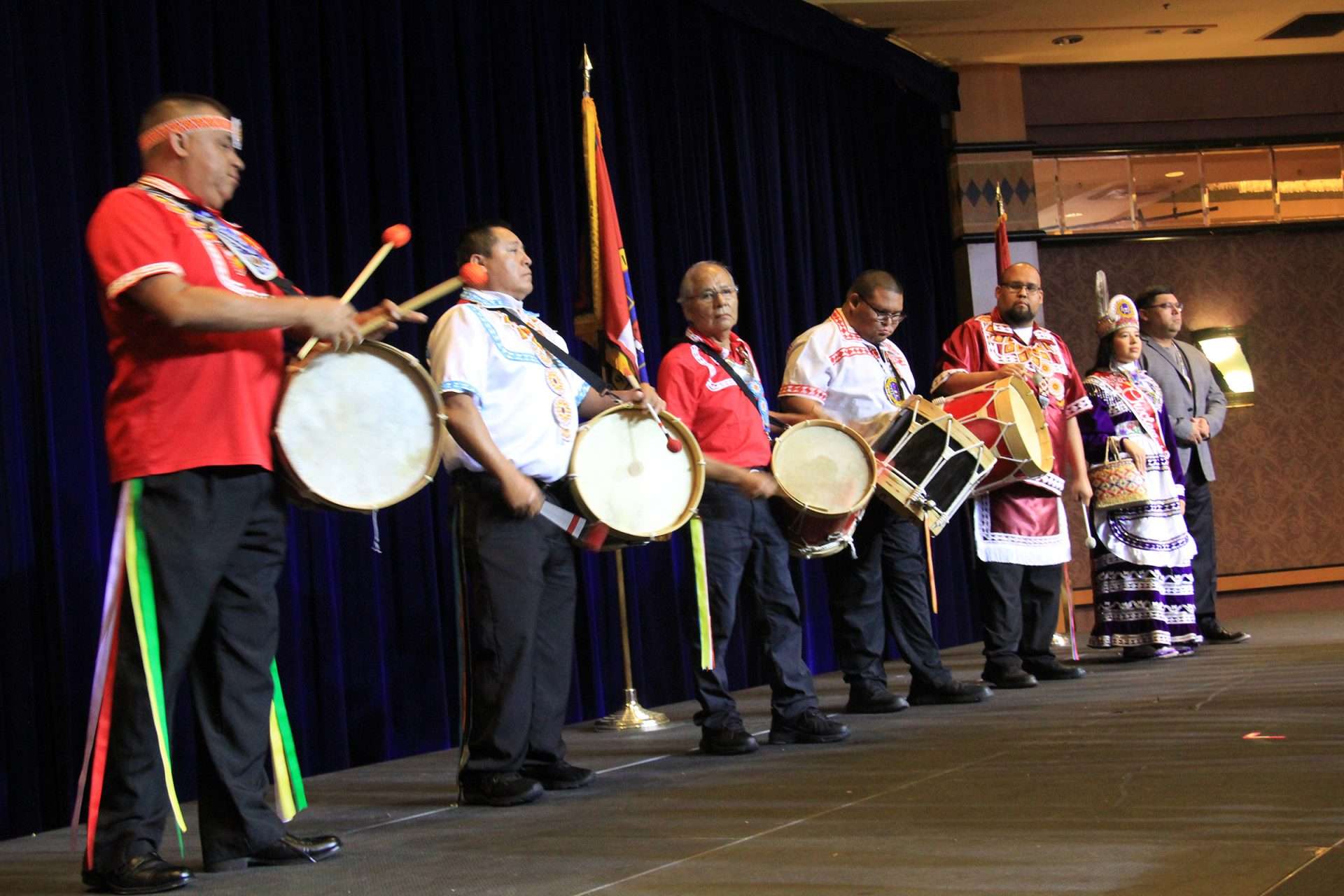
Drumming punctuated the program opening and afternoon social dances by senior tribal members dressed in brightly colored regalia decorated with intricate beadwork. During a noon program, drummers sang in their ancestral tradition to the rhythmic sound of a drum.
Choctaw Chief Cyrus Ben said: “We refer to it as the heartbeat of the people. It’s our people speaking to us.”

The U.S. government’s adoption of ICWA to enforce children’s right to their culture 47 years ago was a course reversal after more than a century of policies and practices that were meant to extinguish Indian culture. American Indian boarding schools that began in the 1800s sought to “civilize” Native American children by replacing all that they knew with English language, Christian religion and non-Native dress. Children were punished for speaking their native language.
“The goal was to strip away the Indian identity and leave a brown-skinned white person,” said retired Judge William A. Thorne Jr. of San Diego. “The goal was cultural eradication.”
Boarding schools included church-affiliated programs approved by the federal government as well as schools operated by the Bureau of Indian Affairs. Families were forced to send their children to the boarding schools, Thorne said. In 1894, 19 Hopi men were arrested for resisting U.S. government policies, including forced removal of their children to Indian boarding schools. They spent nine months in Alcatraz. A more broadly applied tactic was to withhold resources — food, clothing and blankets — from families who resisted sending their children to boarding schools.

Many children died in the boarding schools. “Oftentimes the families never knew what happened to these kids. The schools never bothered to notify the family,” Thorne said. Some tribes have been fighting for years to have the remains of children repatriated to their homes. Many are lost in unmarked graves.
Tiny sets of handcuffs are among the grim relics of the boarding schools. They were intended to keep children from running away.
Those who survived the experience of boarding schools lost their cultural identity as well as basic notions of what family life should look like. Children reared in dormitories didn’t learn parenting skills, leading to dysfunctional families and intergenerational trauma, Thorne said.
In the waning years of the boarding schools, another government program aimed at assimilation took its place. Indian children were removed from their families and adopted out to mostly white families. The Indian Adoption Project, which ran from 1958 through 1967, was carried out by the Child Welfare League of America and the Bureau of Indian Affairs. Thorne said that during that time, between 25% and 35% of Indian children were sent to non-Indian homes.
Congress passed the Indian Child Welfare Act in 1978 in response to the high numbers of adoptions into non-Indian families.
A 1989 landmark U.S. Supreme Court case that interpreted the enforcement of ICWA originated in Mississippi. In the court’s decision in Mississippi Band of Choctaw Indians v. Holyfield, Justice William Brennan Jr., writing for the majority, recounted history that preceded Congress’ adoption of ICWA, noting that the legislation “was the product of rising concern in the mid-1970s over the consequences to Indian children, Indian families, and Indian tribes of abusive child welfare practices that resulted in the separation of large numbers of Indian children from their families and tribes through adoption or foster care placement, usually in non-Indian homes.”
Thorne, a Pomo/Coast Miwok Indian, became a judge in 1979, a year after ICWA was enacted. He worked for more than 34 years as a tribal court judge in Utah, Idaho, Montana, New Mexico, Colorado, Arizona, Wisconsin, South Dakota, Nevada, California, Nebraska, Oregon and Michigan. He was the first Native American to serve on the Utah Court of Appeals. He now spends part of his time teaching about ICWA.
He told conference participants that some of what he teaches comes from 40 years of his own mistakes. He walked them through a long list of lessons learned from his own errors. Recalling some of his own adjudications, he said: “I removed kids when it wasn’t necessary. We are actually adding trauma in the name of helping those kids. Foster care should be a last resort.”
He emphasized helping families be better parents, and if they can’t do that, looking for placement with other family members. “Our concern is not to make them perfect parents. Our concern is that the kids be safe at home,” he said. “Our success should only count when we help them to succeed. Our job is to help them keep their kids at home. … Family matters. Children need to belong.”
Judge Kathleen Quigley of Tucson, Arizona, is president of the National Council of Juvenile and Family Court Judges. She established the Indian Child Welfare Act Court in Pima County in 2020. Coming from a state with 22 federally recognized Indian tribes, she is strong on ICWA training. However, she thinks back to 2009, when she became a Pima County Juvenile Court commissioner. “I didn’t know the law. I didn’t know how to apply it.” Training was a 15-minute introduction to ICWA.
“It’s really about the training and the letter of the law,” Quigley said. “A hallmark of our court is education and training.”
She reiterated the necessity for case workers, attorneys and judges to be mindful of the possibility that a child has Indian heritage, and to ask early.
“Children have a right to their families. Those children need that connection to their families, their tribe,” Quigley said.
She told conference attendees to ask themselves: “What can we do to do a better job?”
“They need a champion. That’s why you are here,” she said.
“Every child that we see matters.”
The post Indian Child Welfare Act Conference strengthens training, highlights culture appeared first on Darkhorse Press.